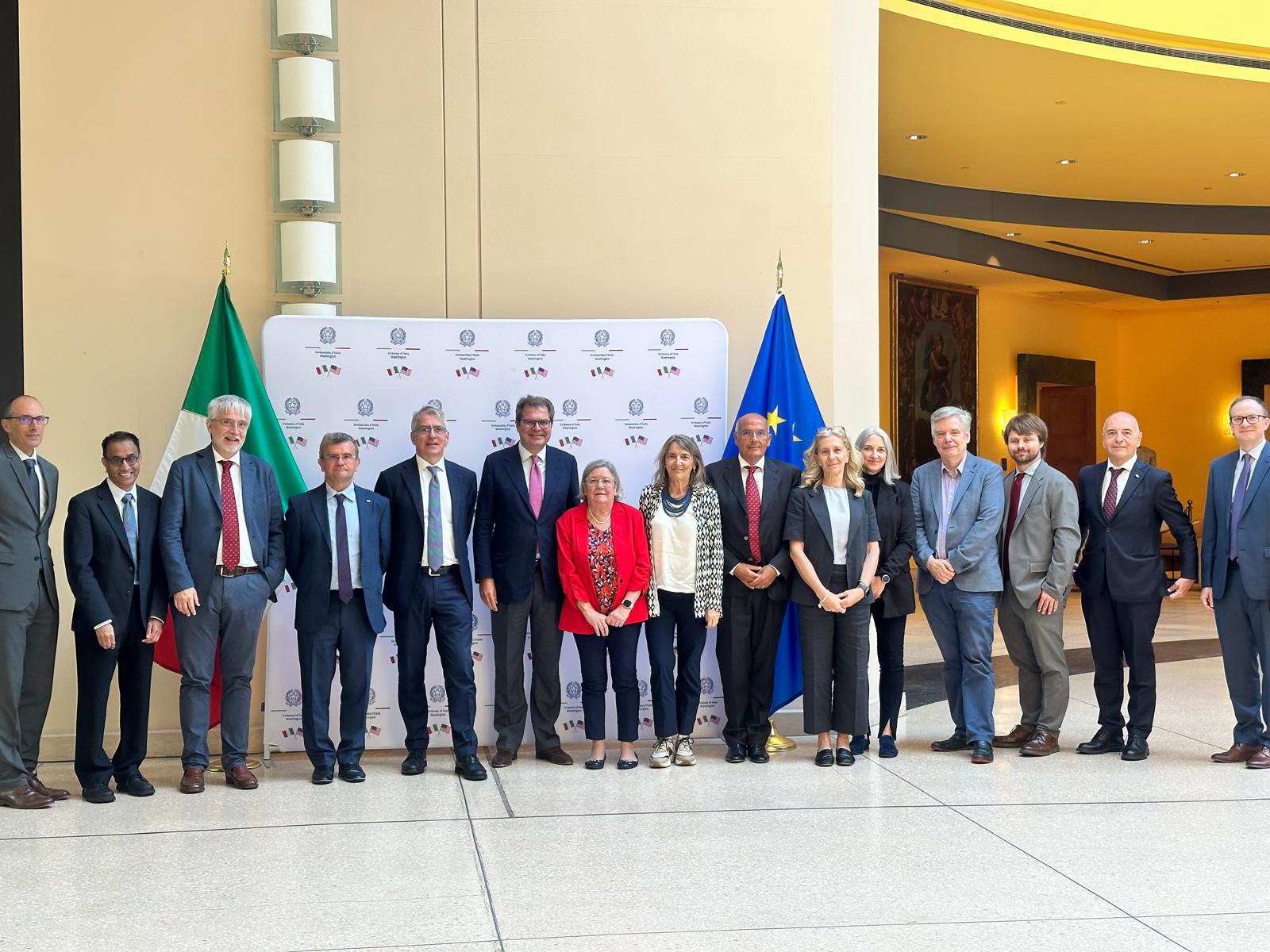
On September 2 and 3, the Embassy of Italy in Washington hosted a meeting between Italy and the United States aimed at strengthening and renewing the long-standing scientific cooperation between the two countries and taking stock of joint initiatives in the fields of fundamental physics and emerging technologies. This annual two-day event brought together a delegation from the National Institute for Nuclear Physics (INFN) and U.S. delegations from the Department of Energy (DOE) and the National Science Foundation (NSF), the primary federal agencies funding scientific research in the United States.
Discussions covered numerous topics of interest to the physics community, starting with large-scale accelerators for particle physics research. In particular, participants examined ongoing activities at CERN (the European Organization for Nuclear Research) and potential future collaborations on the Future Circular Collider project, as well as the progress of the Electron-Ion Collider, currently under construction at the Brookhaven National Laboratory, designed to study the properties of nuclear matter.
Significant attention was also given to neutrino physics, with updates on the DUNE (Deep Underground Neutrino Experiment) project in the United States and the future LEGEND experiment, which will search for neutrino-less double-beta decay and be hosted at INFN’s Gran Sasso National Laboratories.
Gravitational-wave research was also discussed, ranging from current collaborations between the Virgo and LIGO groups to future prospects involving the next generation of observatories: the Einstein Telescope and Cosmic Explorer. Direct searches for dark matter were also addressed, with specific reference to the DarkSide and XENON experiments located at INFN’s Gran Sasso National Laboratories.
Cooperation between Italy and the United States also extends to emerging technologies, including advanced computing, artificial intelligence, high-performance computing, and quantum technologies. The meeting focused on the development of quantum computing, taking stock of the project coordinated by Fermilab’s Superconducting Quantum Materials and Systems (SQMS) Center to build a future quantum computer, a project in which INFN was the first non-U.S. international partner.
“Scientific cooperation between Italy and the United States stems from a solid relationship built over time between our research communities,” noted Marco Peronaci, Italy’s Ambassador to the United States. “In a rapidly evolving sector, pooling expertise, infrastructure, and technological capabilities fosters innovation and creates new opportunities for collaboration between the two countries.”
“The meeting in Washington was an important opportunity to renew scientific collaboration between Italy and the United States,” stated Antonio Zoccoli, President of INFN. “Our scientific communities are working side-by-side on numerous strategic projects: from particle physics to neutrino research, from gravitational waves and dark matter to quantum technologies and the new frontiers of computing. This collaboration is grounded in shared expertise, infrastructure, and projects, with Italy making a leading scientific and technological contribution. It is a source of great satisfaction for INFN to make its community’s expertise available to these major international programs while simultaneously continuing to build new research and innovation opportunities with our U.S. colleagues.”
September 4, 2026